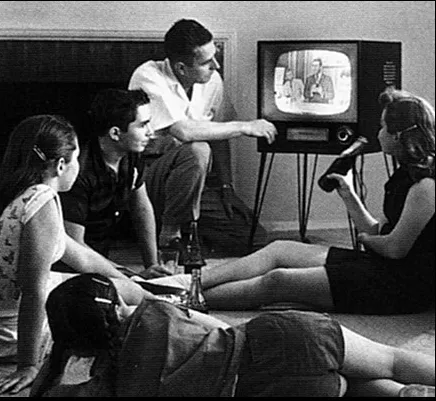
Go Ahead, Love Your Fictional Boyfriend: Why Parasocial Bonds Are Actually Your Fandom Superpower
Photo: Gannu03, CC BY-SA 4.0, via Wikimedia Commons
Somewhere along the way, "parasocial relationship" became a term people use like an insult. You mention that you cried when your favorite streamer went on hiatus, and suddenly someone's sliding into your mentions with a concerned-emoji energy and a Wikipedia link. As if caring deeply about someone whose work has shaped your daily life — even if they don't know your name — is some kind of personality defect requiring intervention.
We'd like to formally, enthusiastically, and with great comedic energy, push back on that.
At DittoHolic, we are in the business of obsession. We believe that loving something — a show, a character, a creator — with your whole chest is not a problem to be solved. It is, in fact, a superpower. And the psychology, the culture, and the community all back us up on this.
First, Let's Actually Define the Thing
A parasocial relationship is, at its most basic, a one-sided emotional connection. You feel like you know someone — a celebrity, a fictional character, a YouTuber — even though that relationship isn't mutual in the traditional sense. You follow their work, you invest in their story, you feel something real when things go well or badly for them.
Psychologists coined the term back in 1956, and for a long time it carried a vaguely clinical, slightly alarming connotation. But here's what the more recent research is showing: these connections are not inherently unhealthy. They are, in many ways, a completely normal extension of how human beings form emotional bonds — through story, through repeated exposure, through shared experience.
In other words, your brain doesn't distinguish sharply between "person I see at work every day" and "person whose podcast I've listened to for 400 hours." Both relationships feel real because, emotionally, they kind of are.
The "But That's Embarrassing" Problem
Here's where American pop culture has done fans a genuine disservice. There's a long tradition — particularly in mainstream media — of mocking intense fan devotion. The hysterical Beatlemania footage played for laughs. The "Twilight mom" jokes. The endless "parasocial" callouts on stan Twitter whenever someone expresses a feeling that's deemed Too Much.
But who decided what "too much" looks like? And why does it seem to apply disproportionately to the kinds of fandoms that skew female, or young, or otherwise easy to dismiss?
"I've been a fan of the same band since I was 15," says Dani, a 29-year-old from Nashville. "I've traveled across three states to see them live. I've made some of my closest friends through that fandom. And for years I was kind of embarrassed to admit how much it meant to me, because people acted like it was pathetic. It took me a long time to realize that what I'd built — the community, the experiences, the emotional connection — was genuinely valuable."
It is. Full stop.
The Community Effect: Parasocial as Social
Here's the twist that doesn't get talked about enough: parasocial relationships are almost never just parasocial. They are the entry point into real, reciprocal communities.
You start watching a show because a character feels like they get you. Then you find the subreddit, the Discord, the fan account. You make a friend at a convention. You write a comment on someone's fan theory and they write back and suddenly you're texting. The one-sided connection with a fictional entity or a celebrity becomes the seed of dozens of genuine human relationships.
"My best friend and I met because we both loved the same obscure streaming series," says Marcus, a 33-year-old from Portland. "We bonded over our parasocial attachment to the same character. That's literally how we introduced ourselves. And now we've been friends for six years. You can't tell me that's not real."
The data supports this. Studies have shown that parasocial relationships increase feelings of belonging, reduce loneliness, and serve as social rehearsal — helping people practice empathy and emotional connection in a lower-stakes environment. For people who struggle with social anxiety or isolation, fandom communities built around shared parasocial bonds can be genuinely life-changing.
In 2024, It's Not Even That Weird Anymore
Something shifted in the cultural conversation around this, and if we had to point to a moment, it might be the pandemic. When everyone was isolated, the parasocial relationships people had with streamers, podcasters, and fictional characters became an acknowledged lifeline. Suddenly it wasn't embarrassing to admit that your parasocial bond with a late-night host was getting you through the week. Everyone was doing it. Everyone needed it.
Fast forward to now, and the normalization has continued. Celebrities openly discuss their own parasocial relationships with their fans. Streamers build entire business models on the intimacy of the format. Shows are written with explicit awareness that viewers form deep attachments to characters. The entertainment industry has fully accepted that parasocial connection is a feature, not a bug.
And fans? They're finally starting to accept it about themselves.
The Superpower Part (We Promised)
So here's the actual thesis, stated plainly: the capacity to form deep emotional investments in people and characters you don't personally know is not a weakness. It is evidence of a highly developed imagination, strong empathic ability, and a genuine hunger for connection and meaning.
Fans who've built parasocial relationships with creators report higher levels of motivation and creative output — they make fan art, they write fiction, they analyze and discuss and theorize. Fans who feel connected to fictional characters often cite those characters as genuine influences on their values, their resilience, and their sense of self.
That is not embarrassing. That is a person using every tool available to them to build a rich inner life and a community of like-minded humans. That is, by most definitions, thriving.
"I used to joke that my parasocial relationships were a coping mechanism," says Dani. "But honestly? They're more than that. They're part of how I understand myself. The things I love say something true about who I am."
Obsessed and proud. That's not a confession. That's a flex.
So the next time someone tries to make you feel weird about ugly-crying over a TV finale or defending a streamer you've never met, just smile. You have a superpower. Not everyone can access that level of feeling. They're missing out.